Integrating Videogame Element Icons into Your Creative and Professional Workflow
Visual communication is a critical component of modern digital projects. Whether you're designing a website, developing a mobile app, or creating marketing materials, the need for clear, engaging, and thematic iconography is universal. Videogame Element Icons provide a specific and versatile solution, offering a collection of symbols inspired by the familiar and engaging world of gaming. This set is not merely a themed asset pack; it's a practical tool designed for seamless integration into a wide range of professional and creative workflows.
A Cohesive Visual System for Multiple Platforms
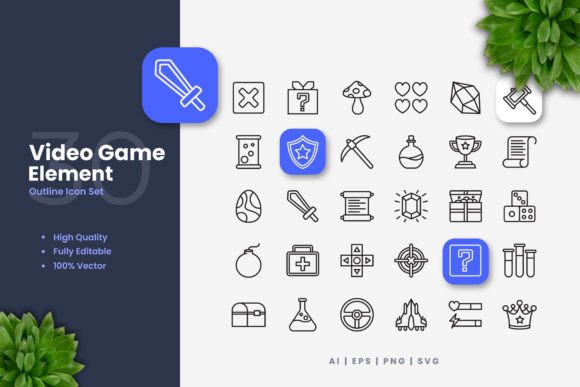
The core value of Videogame Element Icons lies in their application across disparate mediums. The set includes 100 vector icons, each representing a common element from video game interfaces, such as health bars, power-ups, controller buttons, shields, and character status indicators. These icons carry an inherent association with interactivity, progression, and digital systems, making them particularly effective for projects that aim to convey concepts of achievement, status, functionality, or technological engagement.
Consider a small business owner building an e-learning platform. Using a "quest completion" icon to mark finished modules or a "key" icon to signify unlocked content leverages familiar metaphors to enhance user understanding. A marketer designing a social media campaign for a new software tool could use "power-up" icons to represent feature benefits or "shield" icons to denote security advantages. The thematic consistency provided by Videogame Element Ics creates a subtle narrative thread across banners, flyers, and infographics.
From Source File to Final Implementation
The technical design of this icon set is deliberately process-oriented. Provided as fully editable vector source files (AI, EPS 10, and SVG), the icons are built for modification. This is a key integration point in a creator's workflow. You are not receiving static, one-size-fits-all PNGs. Instead, you receive the raw components, allowing you to tailor the assets to your project's exact specifications during the design phase.
For instance, if your brand guidelines require a specific color palette, you can open the AI file in Adobe Illustrator and globally adjust the stroke and fill colors to match. If your mobile app interface demands a thinner stroke weight for better clarity on small screens, you can modify the vector paths in CorelDRAW without any loss of quality. This level of customization ensures that the Videogame Element Icons can be adapted to maintain visual consistency with your existing design system, rather than forcing you to compromise your brand identity.
Practical Integration in Common Project Lifecycles
The utility of these icons manifests at different stages of a project's lifecycle. During the initial planning and wireframing stage for a website or app, designers can utilize the PNG files—provided with transparency—to quickly place conceptual icons into mockups. This allows for early stakeholder feedback on the thematic direction without committing to final design hours. The easy drag-and-drop nature of the PNGs facilitates rapid prototyping.
As the project moves into the execution and production phase, the vector source files become central. Developers or graphic designers integrate the finalized SVG icons into code for web applications, ensuring scalability and performance. Print designers use the adjusted EPS files for high-resolution output on posters or physical banners. The included Readme.txt file typically contains essential information on file structure and usage recommendations, aiding in the efficient handoff between team members, such as from a designer to a developer.
Ensuring Long-Term Usability and Organization
A professional workflow considers not just immediate use, but long-term asset management. The 100 customizable icons represent a substantial library. A practical tip for integration is to organize them within your project's asset folder structure immediately upon acquisition. You might create subfolders for "Navigation Icons," "Status Icons," and "Decoration Icons" based on your anticipated use cases. This preemptive organization saves significant time during the intense design and implementation phases, when quickly locating the correct symbol is crucial for efficiency.
Quality control is inherently maintained through the vector format. Because you are editing mathematically-defined paths, there is no pixelation or degradation when resizing for different outputs—from a tiny app button to a large conference poster. This guarantees a consistent quality outcome across all uses, a fundamental requirement for professional-grade work. Furthermore, owning the source file means the set is a durable, long-term resource. As your projects evolve, you can revisit and re-edit the same Videogame Element Icons for future campaigns or products, ensuring a coherent visual history for your brand or portfolio.
Complementing Other Tools and Resources
Videogame Element Icons do not function as a standalone tool; they interact dynamically with other assets and software in your ecosystem. They are designed to complement your existing typography, color schemes, photography, and other graphical elements. In a comprehensive branding document or style guide, these icons would be listed as a component of the visual identity, with specifications on their approved modifications for different contexts.
For educators or bloggers creating infographics, the icons can be combined with data visualization tools in software like Adobe Illustrator or Canva. The clear, simple and clean icon design ensures they do not overpower complex charts or dense text, but rather enhance the visual hierarchy by providing intuitive symbolic anchors. For freelancers and entrepreneurs working with limited resources, this single, multipurpose set reduces the need to source or purchase disparate icon packs for different projects, streamlining both budget and creative decision-making.
Final Workflow Observations
Ultimately, the effective use of Videogame Element Ics hinges on seeing them as flexible, high-quality building blocks. Their integration is less about a rigid step-by-step process and more about understanding their potential application points within your unique workflow. Start by auditing your current project's needs: where could a symbolic, gamified element improve communication? Then, leverage the technical strengths of the pack—the editable vectors for customization and the multiple file formats for cross-platform compatibility—to implement those icons seamlessly.
By focusing on this blend of thematic relevance and practical technical design, Videogame Element Icons move beyond mere decoration. They become a functional part of the planning, execution, and delivery of your work, aiding in creating more engaging, consistent, and professionally polished outcomes across websites, mobile apps, print media, and beyond.