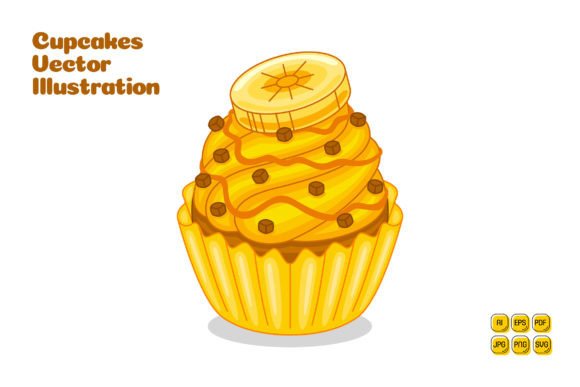
Unlocking Creative Versatility with the Banana Caramel Cupcake Illustration
When you first encounter the Banana Caramel Cupcake Illustration, it might simply appear as a charming graphic of a delicious dessert. However, its true value lies far beyond its initial subject. This vector illustration, and the accompanying extensive pack, represents a powerful tool for digital creation, designed to be deconstructed, recolored, and recombined to fit an almost infinite array of projects.
Why a Single Illustration Can Be a Creative Powerhouse
Many creators and business owners look for graphics with a very specific, final-use mindset. They search for “a cupcake banner” or “a social media post about desserts.” This approach often leads to purchasing numerous single-use assets, creating a cluttered library of files that are difficult to adapt. The Banana Caramel Cupcake Illustration is engineered to counter this. Each element—from the banana slice to the caramel drip, the cupcake base to the wrapper—is an independent, editable vector shape. This means you aren’t just buying a picture; you’re acquiring a modular kit of visual components.
The common oversight here is viewing it as a static image. The better approach is to see it as a foundational design system. For a marketer, the banana element could be extracted and used in a healthy snack infographic. For a teacher, the caramel swirl could become a fun visual in a chemistry lesson about viscosity. The flat design style ensures clarity at any size, from a website hero banner to a tiny app icon, making it a versatile core asset.
The Critical Mistake of Ignoring File Format Compatibility
A frequent, costly misunderstanding involves file formats. Downloading a single JPG or PNG might seem sufficient, but these raster images lock you into a fixed resolution and color scheme. Attempting to resize a JPG for a large banner can result in blurry, pixelated graphics that harm your brand’s presentation. Similarly, trying to change the color of a cupcake wrapper in a PNG file is an inefficient, pixel-level editing nightmare.
The provided package, which includes AI, EPS, SVG, and PDF files alongside high-resolution raster files, is specifically crafted to prevent this. The vector formats (AI, EPS, SVG) are your keys to true customization. They allow you to open the illustration in Adobe Illustrator or similar software and edit every single shape with a click—changing colors, scaling elements infinitely without quality loss, or separating the sprinkles from the frosting to use elsewhere. Before purchasing any illustration asset, always verify it includes native vector source files. Using only the pre-made JPG is like buying a cake when you really need the ingredients and recipe to bake your own variations.
A Practical Checklist Before You Use or Customize
To ensure you leverage this asset correctly, pause before opening the files. First, confirm your software can handle vector formats. Adobe Illustrator is ideal, but free alternatives like Inkscape can work with SVG files. Second, define your project’s scope. Ask yourself: “Do I need just the final image, or do I need to adapt it?” If adaptation is needed, start directly with the AI or EPS file. Third, plan your color changes. Since each shape is editable, you can coordinate them with your brand palette seamlessly—turn that caramel into a blueberry drizzle or make the wrapper match your corporate colors. This proactive planning transforms the asset from a decorative insert into an integral part of your design workflow.
Overlooking the Potential for Combined Element Creation
Another underutilized feature is the ability to combine elements from within the larger Cupcakes Vector Illustration pack to create entirely new illustrations. Users often stick to the pre-composed scene, like the complete Banana Caramel Cupcake Illustration, fearing that dismantling it is too complex. This limits creativity. For instance, you could take the cupcake base from one illustration, the frosting swirl from another, and a different topping from a third, merging them in a new document to create a unique cupcake design for a specialized promotion.
The impact of not exploring this is a less distinctive visual identity. Your graphics might look similar to others who bought the same pack. The corrective advice is to embrace the modularity. Start a new project by importing multiple AI files and using layers to pick and place components. This method allows a small business owner to generate a whole series of cohesive yet distinct graphics for a campaign, all stemming from one core resource, saving immense time and cost compared to commissioning custom art for each variation.
The Resolution and Size Trap: Assuming Bigger is Always Better
There’s a reassuring comfort in seeing “High Resolution” and “Size 3389 x 4500 pixel” listed. However, a mistake is to assume this large raster output is the primary file for all use cases. While the high-res JPG and PNG are excellent for quick, quality placements where no editing is needed, over-reliance on them for editable projects leads back to the limitation problem. The true size flexibility comes from the vector files, which have no pixel dimensions at all—they scale mathematically.
A better approach is to use the correct file for the task. For a fixed social media post, the transparent PNG might be perfect. For a logo adaptation or a scalable background pattern in a web design, the SVG or AI file is indispensable. This understanding prevents frustration when a client requests a much larger version of a banner, and you can effortlessly scale the vector source, whereas a raster file would require a complete re-purchase or a degraded redesign.
From Passive Consumer to Active Designer
The ultimate advice for using this illustration pack is to shift your mindset from consumer to co-designer. The product offers the raw ingredients—100 vector illustrations in a consistent flat style. Your creativity provides the recipe. Instead of searching for another “perfect” stock image for your next blog, landing page, or infographic, consider how you can modify an existing element from this collection. Can the cupcake shape become a progress meter icon? Can the banana slice illustrate a “natural ingredient” section? This active, editorial use maximizes your investment, turning a one-time purchase into a long-term design resource that grows with your needs.
By focusing on the editable vector core, checking your software compatibility, and daring to disassemble and recombine elements, you avoid the common pitfalls that render many graphic purchases short-lived and inflexible. The Banana Caramel Cupcake Illustration, therefore, isn’t just a depiction of a treat; it’s a treat for any designer or content creator looking to blend efficiency with unlimited creative potential.