A Practical Guide to Selecting a Modern Technology Icon Pack for Your Project
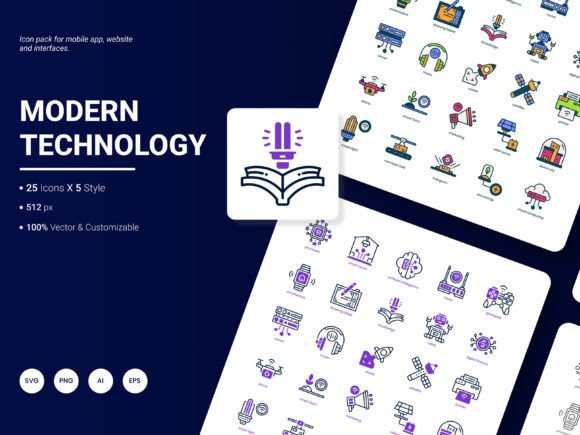
In the landscape of digital design, visual communication is paramount. Icons serve as a universal language, conveying complex services and ideas with simplicity and speed. When evaluating icon sets for professional use, one frequently encountered option is a modern technology icon pack, typically comprising a curated collection focused on contemporary digital themes. Such a pack, often featuring around 25 icons across multiple styles, presents itself as a tool for enhancing websites, apps, presentations, and reports. Understanding its distinct characteristics, how it compares to broader alternatives, and where it fits best can significantly streamline your resource selection process.
What Distinguishes a Modern Technology Icon Pack
While many icon libraries exist, a pack specifically branded as modern technology tends to have a focused scope. Its distinction lies not merely in its aesthetic, described often as fresh and trendy, but in its curated content. It zeroes in on depicting the most popular current services and ideas—think cloud storage, artificial intelligence, cybersecurity, data analytics, and social platforms. This thematic focus is a primary differentiator compared to massive, generalized icon repositories that cover everything from medieval castles to kitchen utensils.
The value proposition often extends into practical delivery. A typical modern technology icon pack offers multiple file formats—comm AI, EPS, SVG, PNG, PDF, and JPG. This multi-format approach is crucial for workflow flexibility. SVG files allow for infinite scaling without loss of quality, essential for responsive web design, while PNGs offer ready-to-use raster graphics for quick placement. The inclusion of AI and EPS files speaks to an audience comfortable with advanced vector editing software, emphasizing the pack's editable nature. This combination of thematic focus and format versatility creates a specific niche.
Evaluating the Scope: Tradeoffs Between Focused and General Sets
Choosing between a focused pack like a modern technology icon pack and a more general icon library is a fundamental decision. The focused set offers coherence. With 25 icons centered on tech themes, you gain a consistent visual language that immediately signals a tech-oriented context. This can strengthen brand identity and user comprehension in projects like SaaS websites, tech startup presentations, or IT consultancy reports. The limitation, clearly, is scope. If your project requires icons outside the technology domain—for instance, you also need to represent shipping, hospitality, or healthcare—this single pack will be insufficient. You would need to supplement it, potentially leading to stylistic mismatches.
General libraries, often offering thousands of icons, provide unparalleled breadth. They can serve a wider array of projects. However, their tradeoff is often in consistency and curation. Within a massive set, icon styles can vary, and finding a cohesive subset for a modern tech project might require more time and discernment. The modern technology icon pack pre-solves this curation problem, offering a ready-made, stylistically uniform subset. For a project strictly within its thematic boundaries, this saves significant design time.
Considering Style Variations and Editability
A feature like offering 5 styles within the same pack adds another layer of utility. These styles might range from lined to filled, from flat to outline, or include variations in color treatment. This allows a designer to maintain thematic consistency while adapting visual weight and emphasis across different parts of a project—using a bold filled style for primary calls to action and a lighter outline for secondary information. Comparatively, some icon resources offer only a single style, locking you into one visual tone.
The editable aspect is a significant factor for professionals. The availability of vector source files (AI, EPS, SVG) means icons can be tailored. You can change colors to match your brand palette, combine elements, or adjust line weights. This contrasts with many free or low-cost icon sets that offer only static PNG or JPG files, which are difficult to modify without quality loss. This editability makes a modern technology icon pack a more flexible long-term asset, though it requires access to and skill with vector editing tools, which is a consideration for non-designers.
Practical Applications and Best-Fit Scenarios
Where does a modern technology icon pack typically excel? Its design for website design, mobile applications, presentations, analytical reports, and infographics highlights its cross-media utility. For a designer creating a website template for a tech blog or a CRM software dashboard, these icons provide immediate, relevant visuals. In a presentation for a venture capital pitch on a new app, using these icons can create a polished, contemporary look quickly. For an analytical report on network traffic or user growth, the icons can make data categories visually intuitive.
Realistically, its fit is optimal when the project's icon needs are largely confined to the technology and digital service domain, and when a consistent, modern aesthetic is required. It is also a strong candidate when workflow demands multiple formats—perhaps needing SVG for development, PNG for a slide deck, and editable EPS for future brand adaptations. If your team operates without vector software expertise, however, the primary value would then reside in the ready-to-use PNGs or JPGs, and you might weigh the cost against other sets offering similar raster formats.
When Another Option Might Be Necessary
A modern technology icon pack may not be the right choice in several clear scenarios. If your project requires a vast number of icons beyond the 25 provided, even within the tech sphere, you might find the pack limiting. Some projects need hundreds of unique icons for complex interfaces. In that case, a subscription to a comprehensive icon platform or font might be more economical and scalable.
Similarly, if your brand mandates a very specific, non-trendy aesthetic—perhaps a retro, hand-drawn, or ultra-minimalist style not represented in the pack's 5 styles—you would need to look elsewhere. The pack's "trendy" and "fresh" description suggests a current, mainstream design sensibility, which may not align with all brand identities. Furthermore, if budget is a primary constraint and you only need a few specific icons, free resources or open-source icon sets might adequately meet the need, albeit with potential sacrifices in consistency and editability.
Making an Informed Decision: Key Factors to Weigh
Selecting any design resource involves weighing several factors. For a modern technology icon pack, consider these points:
- Theme Alignment: Does the list of "most popular services and ideas" covered by the 25 icons match your project's actual needs? Review the specific icons before purchase.
- Format Requirements: Assess your workflow. Do you need editable vectors for customization, or are pre-made raster files sufficient? The 6-format offering is a benefit only if you utilize those formats.
- Style Consistency: The 5 included styles offer flexibility. Compare this to other options that might offer a single style or a completely different stylistic range.
- Scale and Scope: Is 25 icons enough? For a small project, it might be perfect. For a large, evolving one, it might be just a starting point.
- Long-term Value: Editability means the pack can be adapted for future projects, increasing its asset value over time compared to static, non-editable graphics.
The pack positions itself as a balanced solution—not the exhaustive library, nor the single-icon freebie. It offers a curated, versatile, and professional-grade middle ground. Your decision ultimately hinges on whether that middle ground aligns with your project's specific thematic, stylistic, and practical requirements. By comparing its focused offering against the extremes of vast libraries and limited free assets, you can determine if it represents the most efficient and effective resource for your current design challenges.
For those who find such a pack useful, its creators often invite suggestions for future updates. This collaborative aspect indicates an evolving resource that may expand based on user needs, potentially addressing limitations in scope over time. Engaging with that process can be a way to shape a tool that better serves the community of designers and communicators focused on the ever-evolving world of modern technology.