The Essential Guide to Household Equipment Icon Packs for Modern Design
In the digital world, clarity and visual communication are paramount. Whether you're designing a website, crafting a mobile app, or preparing a business presentation, the tools you use to convey ideas can make or break the user's experience. Among these tools, icon packs have emerged as fundamental building blocks. Specifically, a Household Equipment Icon Pack offers a focused collection of symbols that instantly communicate concepts related to home, services, and daily life. This article explores the purpose, significance, and practical application of such a resource, explaining why a well-crafted set of icons is more than just decoration—it's a vital component of effective design.
What is a Household Equipment Icon Pack?
Let's start with the basics. An icon pack is a curated collection of graphic symbols, each representing a specific object, action, or idea. A Household Equipment Icon Pack narrows this focus to items and services commonly associated with domestic life and home-related businesses. Imagine you need to visually indicate "plumbing," "appliance repair," "cleaning services," or "smart home device" on your website. Instead of describing these with lengthy text, a simple, recognizable icon can do the job instantly.
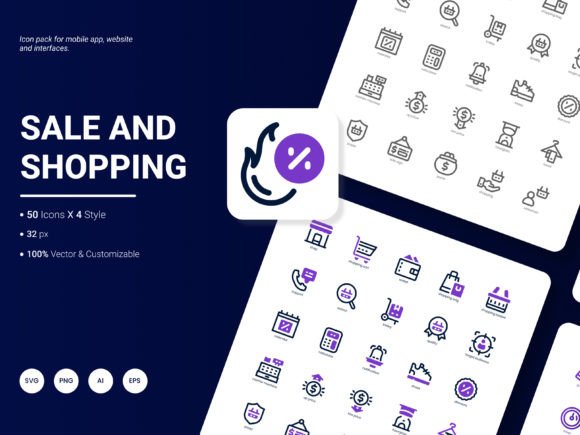
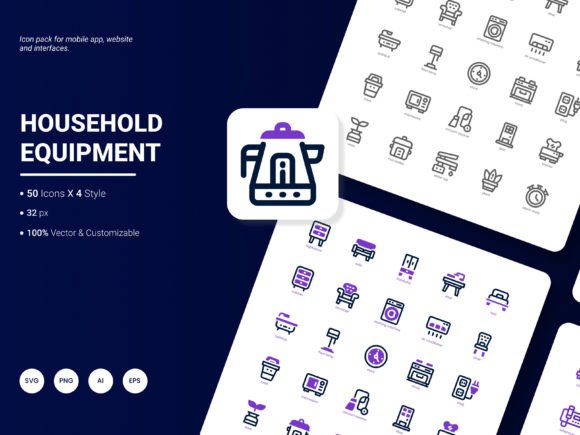
The pack described here exemplifies a robust, modern set. It comprises 50 icons, each rendered in 4 distinct styles. This variety is crucial. One style might be minimalist and flat, perfect for a clean website interface. Another might be more detailed or use a sketched outline, ideal for an informal presentation or infographic. Having multiple styles within one pack gives designers the flexibility to maintain visual consistency while adapting to different tones and contexts.
The Significance and Purpose of Specialized Iconography
Why does a pack focused on household equipment matter? Its significance lies in its targeted utility. In both personal and professional spheres, themes of home management, maintenance, and improvement are ubiquitous. A real estate website needs icons for property features. A home service startup needs symbols for its offered repairs. An analytical report on consumer appliance trends needs clear charts. Generic icons might not perfectly fit these niches, leading to ambiguous communication.
A specialized pack solves this. It serves a clear purpose: to provide immediate, unambiguous visual shorthand for a specific domain. This enhances user understanding, speeds up navigation, and strengthens brand identity by using relevant, cohesive imagery. When users see a familiar icon for a "washing machine" or "thermostat," they process the information faster and with greater confidence than if they encountered a vague or unrelated symbol.
How Icons Fit into Modern Digital Life
Icons are woven into the fabric of our daily digital interactions. From the apps on our phones to the dashboards of smart home systems, icons guide us. In a business context, their relevance is equally strong. For a contractor creating a mobile application for clients, using clear icons for "electrical work," "carpentry," or "HVAC" creates an intuitive booking interface. In education, a teacher creating an infographic about energy consumption at home can use icons for various appliances to make the data accessible.
Their role extends to creativity and technology. Designers and developers are constantly tasked with building interfaces that are not only functional but also aesthetically pleasing and emotionally resonant. A fresh, trendy icon pack, like the one noted here, provides the raw visual elements to achieve that. It saves countless hours of searching for individual assets or creating custom icons from scratch, allowing the creative focus to shift to layout, user experience, and content.
Exploring the Practical Relevance: Formats and Features
The practical value of an icon pack is determined by its technical features. A pack that is difficult to use or limited in format is of little help. This Household Equipment Icon Pack is designed for seamless integration, a key point for its practical relevance.
It is offered in 6 versatile file formats: AI, EPS, SVG, PNG, PDF, and JPG. This is not an arbitrary list; each format serves a distinct purpose in the design workflow:
- AI & EPS: These are vector formats for professional design software like Adobe Illustrator. They allow for infinite scaling without quality loss and are fully editable.
- SVG: A vector format perfect for modern web development. SVG icons can be scaled, styled with CSS, and animated, making them responsive and dynamic.
- PNG: A raster format with transparency, ideal for direct use in presentations, documents, or as static web images.
- PDF & JPG: Useful for quick viewing, sharing, or incorporation into document-based projects.
The editable nature of the vector files (AI, EPS, SVG) is a major advantage. Designers can change colors, adjust line weights, or combine elements to perfectly match their project's brand palette without needing advanced illustration skills. This flexibility ensures the icons don't just fit into your design; they can become a native part of it.
Common Misunderstandings About Using Icon Packs
A common assumption is that using an icon pack is a simple "drag-and-drop" affair with no strategic thought. This underestimates their role. Icons must be chosen with intent. Using too many icons can clutter an interface. Using icons that are too stylistically complex for a minimalist design can create visual noise. Another misunderstanding is that all icons are universally understood. While a "light bulb" for electrical service is fairly standard, more niche items might require slight contextual support, like a label.
The key is to see the icon pack as a toolkit, not a finished solution. The designer's skill lies in selecting the right icon from the 50 available, in the appropriate style (from the 4 options), and implementing it in a way that supports, not dominates, the communication goal.
Applications Across Industries and Projects
The description notes this pack is perfect for a wide range of uses. Let's explore some concrete examples to build a broader understanding of its applicability:
- Website Design: A home services company can use the icons in its service list, feature highlights, and footer contact section. The consistent style across the site builds professional credibility.
- Mobile Applications: An app for managing household tasks or connecting with local repair professionals can use icons as navigation menu items and category markers, creating a smooth, app-like feel.
- Presentations & Analytical Reports: When presenting market research on home appliance adoption, icons can make data charts more engaging and memorable. They serve as visual anchors for complex information.
- Infographics: Creating a step-by-step guide on "Preparing Your Home for Winter" can be dramatically enhanced with icons for insulation, heating systems, and pipe protection.
- Website Templates & Theme Development: Developers building templates for industries like real estate or property management can embed these icons directly, offering more value to their end-users.
In each case, the popular content covered by the icon set—the most requested and recognizable household items and services—ensures it hits the mark for common communication needs.
Building a Cohesive Visual Language
Ultimately, investing in a high-quality, specialized icon pack is about building a cohesive visual language. Just as a writer chooses the right words for a sentence, a designer chooses the right icons for an interface. A Household Equipment Icon Pack provides a consistent "vocabulary" for speaking visually about themes of home.
This consistency is vital for brand identity, user trust, and aesthetic harmony. It allows a small startup to present itself with the same visual polish as a large corporation. It helps educators and analysts present information with authority and clarity. For the individual blogger or creative, it offers a path to professional-looking projects without a massive investment in custom graphic design.
The invitation to provide suggestions for the next update is also a valuable feature. It acknowledges that visual needs evolve. New household technologies emerge, and service categories change. This collaborative approach ensures the pack remains relevant and truly helpful, aligning with the Helpful Content and user-centric principles that define good digital resources.
Conclusion: More Than Just Pretty Pictures
A Household Equipment Icon Pack, especially one with the breadth (50 icons), stylistic variety (4 styles), and technical flexibility (6 editable formats) described, is a strategic asset. It moves beyond being a collection of pretty pictures to become a functional, adaptable toolkit for clear communication. By understanding its purpose—to provide instant, relevant visual shorthand—and leveraging its features across web, mobile, and print projects, designers, developers, educators, and business owners can enhance their work, connect more effectively with their audience, and navigate the digital world with a stronger visual voice.