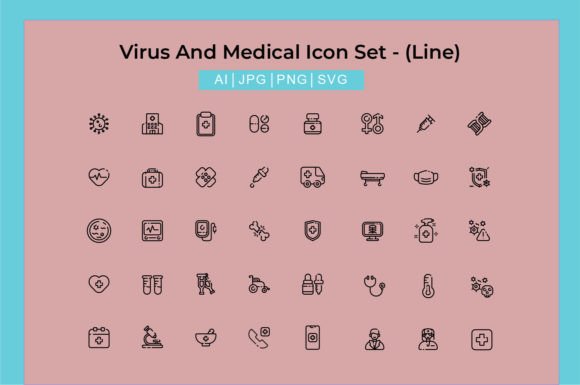
Evaluating the Virus and Medical Icon Set - Line for Professional Projects
In the realm of digital design, particularly for healthcare, science, and public information projects, visual communication is paramount. Finding the right iconography that is clear, accurate, and professionally executed can significantly impact the effectiveness of materials. The Virus and Medical Icon Set - Line represents a specific category of design resource tailored to these needs. It is a collection of vector icons focusing on virology, medical equipment, health symbols, and related concepts, all rendered in a clean, outlined stroke style. This article examines its distinct characteristics, practical applications, and helps you assess whether it aligns with your project requirements compared to other available options.
What Distinguishes This Line Style Icon Set
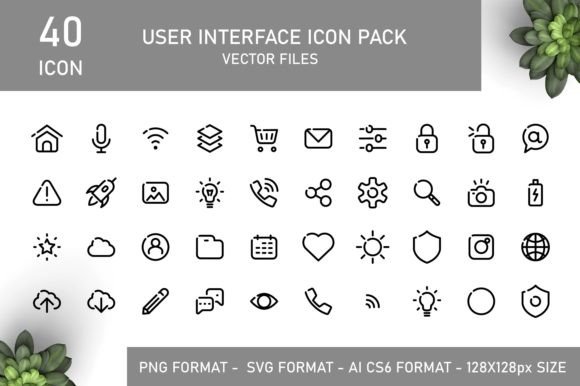
The core defining feature of the Virus and Medical Icon Set - Line is its outlined stroke design. Unlike filled or solid-color icons, this style uses consistent line weights to create the shapes, resulting in a schematic, technical appearance. This can be particularly advantageous for scientific or educational materials where clarity and a degree of formal precision are valued. The "line" approach often feels less decorative and more functional, which can lend authority to infographics, technical documentation, or application interfaces.
Beyond the visual style, the set emphasizes organization and technical quality. A neatly organized file and layer structure within the provided AI and SVG formats is a significant practical benefit for designers who need to customize individual elements. The claim of pixel perfection speaks to an attention to detail in the icon construction, ensuring edges are sharp and aligned, which maintains visual consistency across different sizes and outputs. This meticulousness reduces the time spent on manual corrections, a common frustration with less polished icon collections.
Key Technical Attributes and File Formats
When you acquire this package, you receive forty distinct icons. The base size of 64px provides a substantial starting point, and because they are vectors, scaling up or down does not compromise quality. The inclusion of multiple file formats—AI, SVG, PNG, and JPG—covers a wide spectrum of use cases.
- AI and SVG: These are the editable vector formats. They are crucial for any modification, such as changing stroke colors, combining elements, or adjusting paths. The SVG format is widely supported in modern web development and interactive applications.
- PNG Transparent: This format offers ready-to-use raster images with transparency, ideal for quick placement in digital layouts, web pages, or presentations where vector editing is not required.
- JPG: While less versatile due to its lack of transparency, the JPG format can be useful for certain print contexts or environments where file type restrictions exist.
This multi-format approach provides flexibility, allowing both designers and non-designers (such as content developers or researchers) to utilize the assets according to their technical comfort and project needs.
Practical Use Cases and Project Fit
The Virus and Medical Icon Set - Line is suitable for a variety of mediums, as noted: print, web, symbols, apps, and infographics. Its strength lies in projects that require a cohesive, professional visual language around medical and virological themes. For instance, a university laboratory creating public-facing infection control guides, a health tech startup developing a patient symptom tracker app, or a research institute producing an annual report on pandemic response could all find this set applicable.
The editable nature of the vectors is a major advantage for branding integration. You can easily modify the stroke colors to match an organization's specific color palette, ensuring the icons feel like a native part of the design system rather than a generic add-on. This level of integration can enhance the perceived quality and cohesiveness of the final product.
Considering Limitations and Tradeoffs
While the set offers clear benefits, it is important to consider its scope and style to see if it fits your specific situation. The collection contains forty icons. For a comprehensive project requiring hundreds of medical symbols—covering every type of surgical instrument, pharmacy item, or body system—this set would be a starting point but not a complete solution. You might need to supplement it with other resources.
The line style itself is a key decision factor. Its technical, unfilled appearance might not convey the warmth or approachability desired for certain public health campaigns targeting general audiences. Projects aiming for a more illustrative, friendly, or emotionally engaging tone might better suit filled, colored, or softer illustrative icon styles. The Virus and Medical Icon Set - Line excels in contexts where information clarity and a neutral, authoritative tone are prioritized over stylistic warmth.
Furthermore, the "virus and medical" focus is specific. If your project only peripherally touches on these topics—say, a general wellness blog—a broader health icon set or a more generic line icon library might offer more utility. Evaluating the proportion of icons you would actively use from the forty provided is a simple but effective way to gauge value.
Comparison to Alternative Resources and Approaches
When evaluating icon resources, professionals typically consider several axes: style, specificity, quantity, quality, and licensing. The Virus and Medical Icon Set - Line sits at a particular intersection: it is style-specific (line), theme-specific (medical/virus), and offers a moderate quantity with high-quality construction.
One common alternative is to use large, general-purpose icon libraries that offer thousands of icons in multiple styles. These can be excellent for projects needing a wide variety of symbols across many topics. However, the medical icons within such vast libraries might lack the depth and accuracy needed for specialized projects, and their visual style might not be as consistently applied across the subset you use.
Another approach is commissioning custom iconography. This is ideal for projects with unique branding requirements or needing truly unique symbols not available anywhere else. The tradeoff is significantly higher cost and time. The Virus and Medical Icon Set - Line can serve as a cost-effective middle ground: offering high-quality, editable icons that can be customized to approximate a custom feel without the full expense of bespoke design.
Free icon sets are also widely available. Their tradeoffs often involve inconsistent quality, less organized file structures, restrictive licenses, or lack of editable vector files. For a professional, commercial, or large-scale project, these limitations can introduce risk and extra labor. A purchased set like this one aims to mitigate those practical hurdles.
Making an Informed Decision
Choosing this icon set ultimately depends on a clear match between its attributes and your project's demands. It may be the right choice if your project core theme aligns with virology and medical equipment, you require a technically precise and clean visual style, and you value well-organized, editable vector files for seamless integration and modification. The package structure, offering multiple formats, also supports teams with mixed technical roles.
You might need another option if your project requires a much larger icon count covering broader healthcare topics, a drastically different visual style (like 3D, filled color, or hand-drawn), or if you are working under a license that prohibits using purchased asset sets. In such cases, exploring larger thematic libraries, different stylistic collections, or investigating open-source resources would be prudent steps.
In essence, the Virus and Medical Icon Set - Line is a specialized tool. Its value is highest when the task is specific. By carefully assessing your project's scope, visual tone, technical requirements, and budget, you can determine if this set is a fitting component for your design resources or if your search should continue elsewhere. The goal is always to equip your project with visuals that communicate effectively, support your content, and uphold a professional standard without unnecessary compromise or overhead.